
Direct Mail Didn’t Disappear. It Became Digital, and Now AI Is Reinventing It Again.
In the year 2000, marketing could be surprisingly straightforward.
You purchased or developed a mailing list, created an attractive flyer, printed thousands of copies, put them in envelopes, paid the postage, and waited for the phone to ring.
The basic formula was:
Find a List → Create a Message → Mail It → Generate Leads → Sell
It wasn’t particularly sophisticated, but it worked.
Then several things happened that changed direct mail forever.
Two things impacted the decline of physical mail as a marketing methodology. Fear of the mail and cost.
One unexpected event changed the way many Americans thought about something as ordinary as opening an envelope.
Following the September 11 terrorist attacks in 2001, letters containing anthrax spores were sent through the U.S. mail to news organizations and members of Congress. Five people died and 17 others became ill.
Suddenly, opening an unfamiliar envelope wasn’t always considered harmless.
The anthrax attacks were certainly not the only reason physical direct mail declined. Printing and postage were expensive, email was emerging as an almost instantaneous alternative, and websites were becoming an increasingly important source of information.
Physical mail didn’t just cost more, it now carried a perception of risk that had barely existed before.
The timing was significant.
Just as people were becoming more cautious about opening unsolicited physical mail, a faster and much less expensive alternative was arriving on their computers.
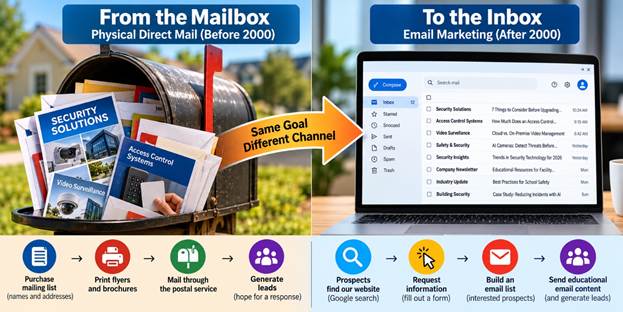
As email became commonplace, marketers discovered that they could accomplish essentially the same thing without printing and postage.
The physical mailing list became an email database. The printed flyer became an HTML email. The mailbox became the inbox.
And distribution became virtually instantaneous.
Instead of spending thousands of dollars printing and mailing 10,000 pieces, a company could send thousands of emails for a fraction of the cost.
The Internet changed something even more important than how we delivered our messages.

Instead of purchasing every new prospect, businesses could now attract potential customers to their websites.
This created an entirely different way of building a mailing list.
A person searching for a product or trying to solve a problem would use a search engine such as Google.
If we had good Search Engine Optimization (SEO), our website might appear near the top of the search results.
The prospect would visit the website, read about a product, download information, complete a form, request a quote, subscribe to a newsletter, or contact the company.
In doing so, the prospect frequently provided an email address.
Now we had something much more valuable than a purchased name.
We had a person who had already demonstrated some interest in what we offered.

For many years, SEO provided businesses with a steady stream of new prospects.
The formula was:
SEO → Google Ranking → Website Visit → Request for Information → New Lead
But search is changing.
AI-generated search results can now answer many questions directly on the search page. A person can research a product, understand alternatives, and obtain useful information without necessarily visiting the websites that provided the underlying expertise.
SEO still matters, but website traffic can no longer be relied upon as the only mechanism for continually generating new prospects.
And that creates an interesting problem. If fewer people visit the website, fewer people fill out forms. If fewer people fill out forms, fewer new names are added to the email database.
The Internet lead-generation machine that helped us build our mailing lists is changing.
So how do we find new prospects?
Ironically, the answer takes us back to where we started.

Before 2000, we found prospects by purchasing mailing lists. During the Internet era, we increasingly allowed prospects to find us through search. Now technology gives us another option.
We can find them again, but much more intelligently.
Modern prospect-discovery platforms can search enormous business databases and identify organizations based on criteria such as:
Industry • Market • Geography • Company Size • Revenue
Then they can identify the appropriate people within those organizations based on:
Job Title • Department • Responsibility • Role • Seniority
Instead of buying a broad mailing list, we can construct a highly focused prospect database.
For example, a security manufacturer might search for:
Industry: Healthcare
Organization: Hospitals and Health Systems
Geography: Northeast United States
Company Size: 500+ employees
Department: Security, Facilities or IT
Role: Security Management
Seniority: Director or above
We aren’t simply creating a bigger list. We’re creating a better list.
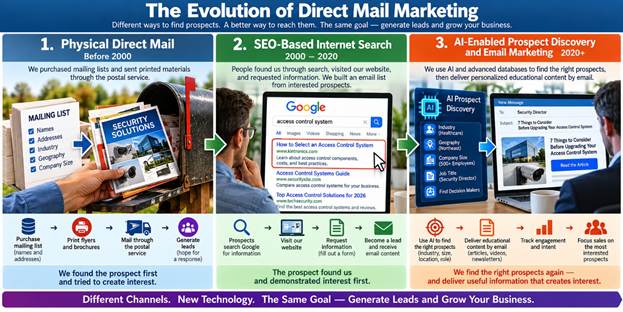
The evolution of direct marketing can now be viewed as three distinct generations.
Before 2000 Direct Mail required a purchased prospect list, printing promotional material, mailing it and then waiting for a response.
After 2000, Internet Marketing and Google search changed our world. We used SEO and hoped that the prospect could find our website. Email requests turned into a lead that we could reply to. The customer found us.
Now we are in the AI-era where our methodology for finding new prospects has changed dramatically. We use AI to help us create a prospect list; we can use automated publishing to electronically send educational content to create interest. We take advantage of intent data feedback so we can focus our sales efforts.
This could be the most important development of all. The technology has changed dramatically. The basic marketing principle hasn’t. The future of direct marketing looks surprisingly familiar.
We have gone back to the future, but this time, we’re bringing AI with us.
If you would like help getting the most out of your marketing budget, please contact us at 914-944-3425, email dennis@kintronics.com, or visit our website kintronicsmedia.com.